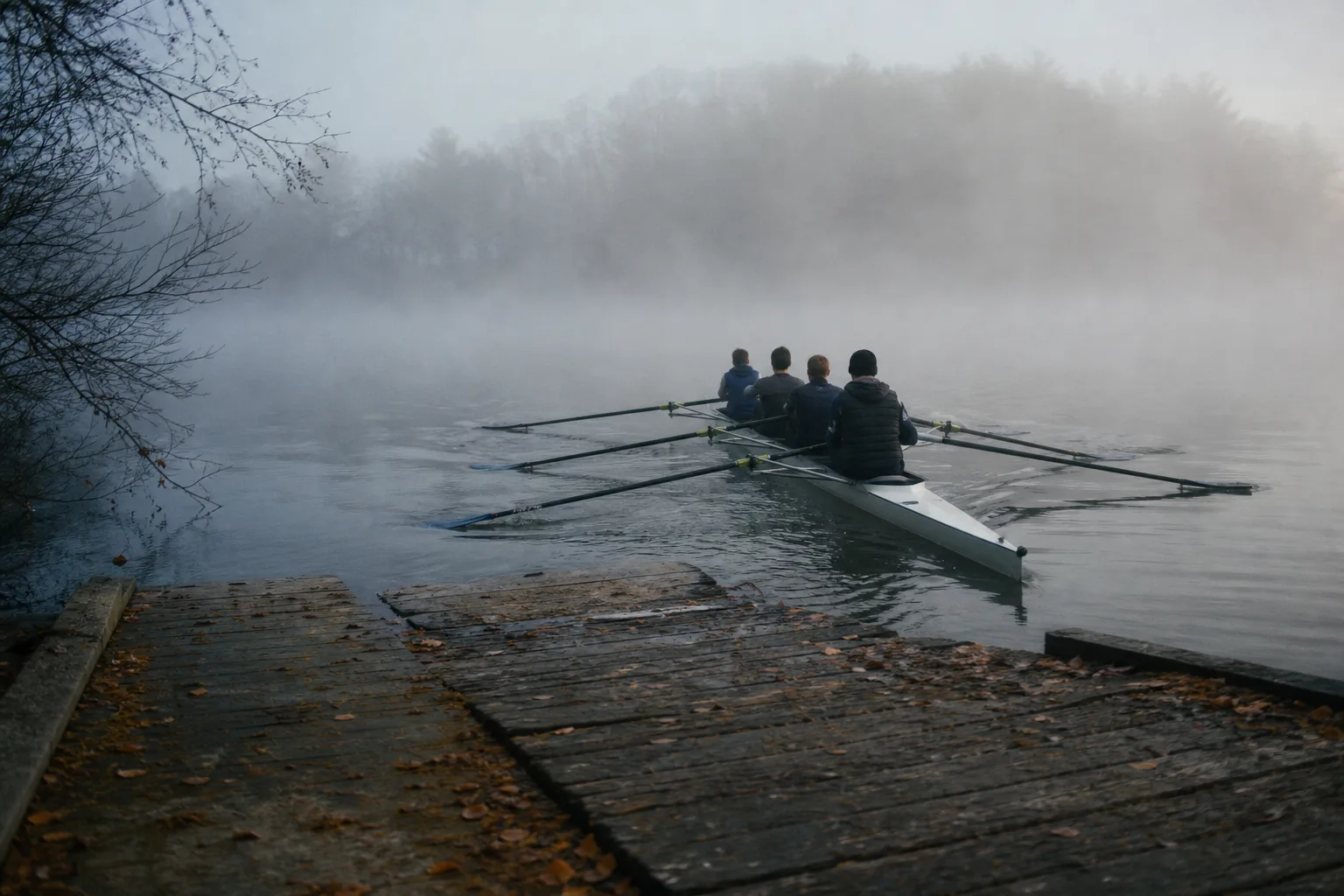
From the bank, Maya Chen’s voice appears to organize the boat. Eight rowers move together after she speaks, blades entering the water in a single line. Inside the shell, cause and effect are less tidy. Chen is listening as much as directing. The sound of catches, the vibration beneath her seat and the quality of the boat’s run all arrive before the next instruction.
A coxswain does not take a stroke. The absence can make the role difficult to explain in a culture that associates contribution with visible effort. Chen steers, calls rhythm, watches traffic and holds the tactical shape of a piece. More quietly, she helps eight people understand what their shared movement is doing.
The voice is not there to fill every silence. It should make the next useful thing easier to notice.
Learning the boat’s language
Chen began rowing at school but remained smaller than most teammates. A coach suggested coxing as though offering an administrative alternative. She resisted. Then she sat in the stern during a technical session and felt information travel through the hull. Every difference in timing had texture. The boat was speaking continuously, without words.
She learned first to steer without overcorrecting. Rivers punish the desire to fix everything at once. A small change requires time to become visible. The same was true of instruction. Early recordings of Chen’s calls are crowded. She narrates effort instead of shaping it. Experience taught her to leave room for athletes to feel what had already changed.
She studies those recordings without listening for whether she sounds commanding. The useful questions are relational. Did a call arrive early enough to be acted upon? Did it describe an effect or merely express frustration? Did the crew improve because of the words, or had the boat already begun to organize itself?
Authority without distance
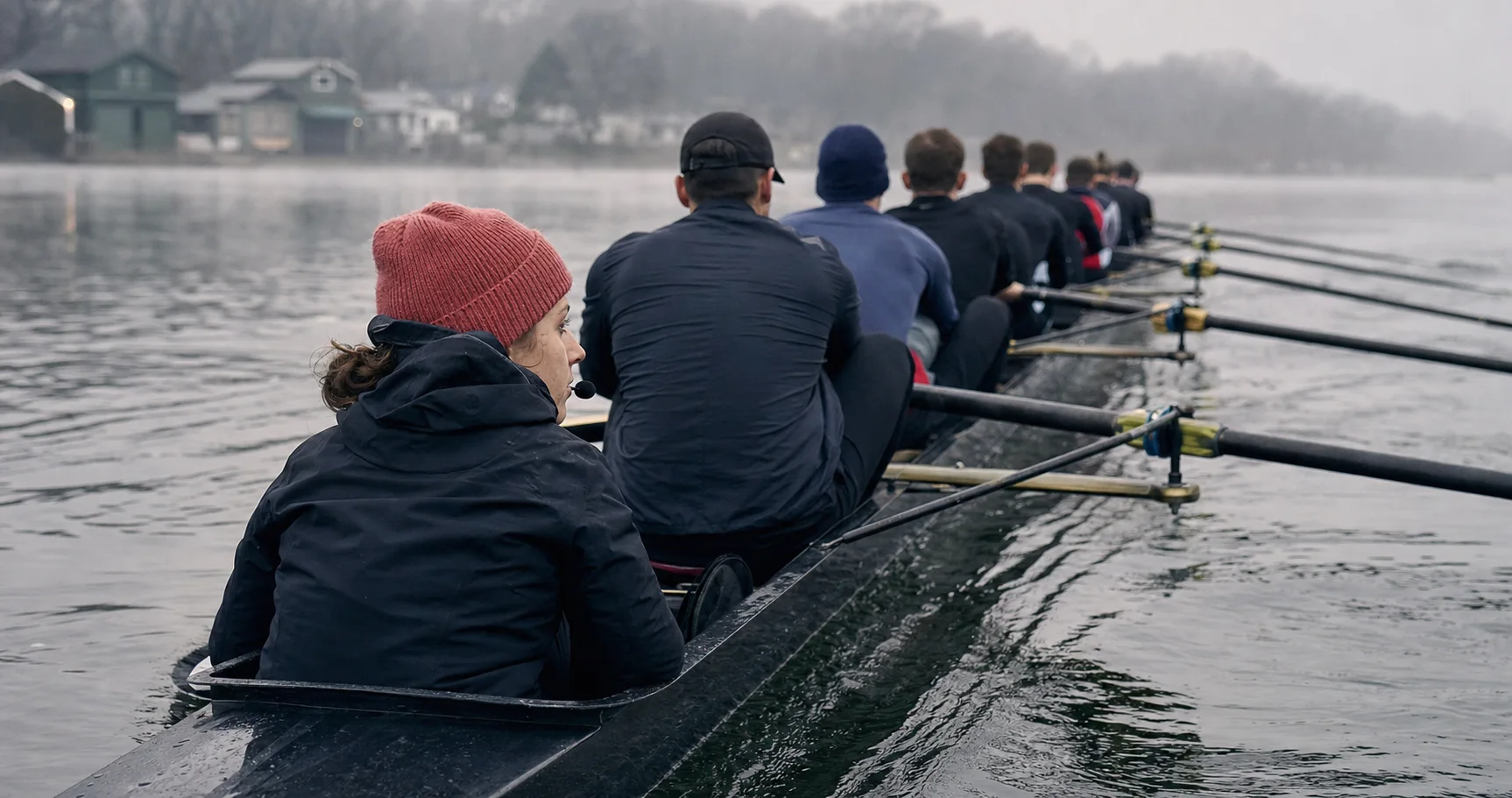
The stern creates an unusual hierarchy. Chen can see the crew, while most rowers cannot see her. Her decisions affect everyone. She treats that asymmetry as responsibility rather than status. Before an outing she asks what each rower is carrying into the boat: a sore rib, a difficult night, anxiety about selection. Not every answer changes the plan, but every answer changes how the plan is held.
During hard pieces, her voice becomes more precise rather than louder. She names rhythm, then one technical focus. When the crew loses connection, she avoids the language of disappointment. The boat does not need to know that it has failed a standard; it needs information that can be acted upon in the next stroke.
Afterward, rowers remember different calls. A phrase that clarified timing for one may have disappeared entirely for another. Chen does not expect language to land uniformly. She asks the crew what they felt, then compares those accounts with her own. Leadership is partly the willingness to discover that the message received was not the message intended.
What arrives together
At the end of the morning, Chen asks the crew to sit balanced for three breaths. The shell is never perfectly still. Water moves beneath it, bodies make corrections and a launch passes beyond the bend. Balance is not the removal of motion. It is a temporary agreement among movements.
Selection season makes that agreement harder. Seats feel scarce and every technical comment can sound like a ranking. Chen cannot remove competition from the boat, but she can prevent ambiguity from doing unnecessary harm. She explains the aim of each session, distinguishes experiment from evaluation and refuses to use uncertainty as motivation.
That clarity has not made every outcome painless. People still lose seats. Crews still disagree about decisions. Chen measures the quality of the process by whether those conversations can remain specific and whether a rower who is disappointed still understands how to participate in the next day’s work.
A voice made with others
Chen’s calls carry phrases borrowed from former coaches and crews. Some have stayed for years; others belonged to one boat and disappeared with its particular chemistry. She does not claim a private language. Coxing is partly an archive of ways people have helped one another notice timing.
She asks rowers which words create movement and which merely create noise. A technically accurate instruction may arrive in a form nobody can use under effort. The crew experiments with images, counts and silence. Precision is measured by response, not by how sophisticated the speaker sounds.
During races, urgency compresses that shared language. A single phrase can carry months of practice because the crew has built its meaning together. Chen’s authority in those moments is real, but it is not improvised command. It is accumulated trust becoming brief enough to fit between strokes.
After the finish, she waits before reviewing. The crew needs water and enough quiet for sensation to become memory. When they speak, she starts with what they noticed. Video and data arrive later, useful but incomplete. The first record is eight bodies and one coxswain trying to describe the same moving event.
The work after speaking
Coxswains are often praised for motivation, a word Chen finds too broad. Some days the crew needs urgency. Other days it needs restraint, a clearer plan or permission to stop interpreting fatigue as a character test. Her work is not to create maximum feeling. It is to help the boat organize the feeling already present.
She prepares calls before a session and crosses half of them out. The remaining phrases are placed beside landmarks and likely changes in effort. Preparation gives her something to depart from. If the boat responds differently, she changes language rather than forcing the crew to complete a speech written on shore.
Younger coxswains sometimes ask how to sound confident. Chen tells them to become specific. Confidence as a vocal style can hide uncertainty from the very people who need to share it. Specific information—distance, rhythm, traffic, one actionable change—allows authority to remain accountable to reality.
On the landing, the rowers lift the shell over their heads. Chen takes one end and walks with them toward the boathouse. Her voice is no longer required, but the coordination remains. Eight people and one coxswain carry the boat inside, still making small decisions together.