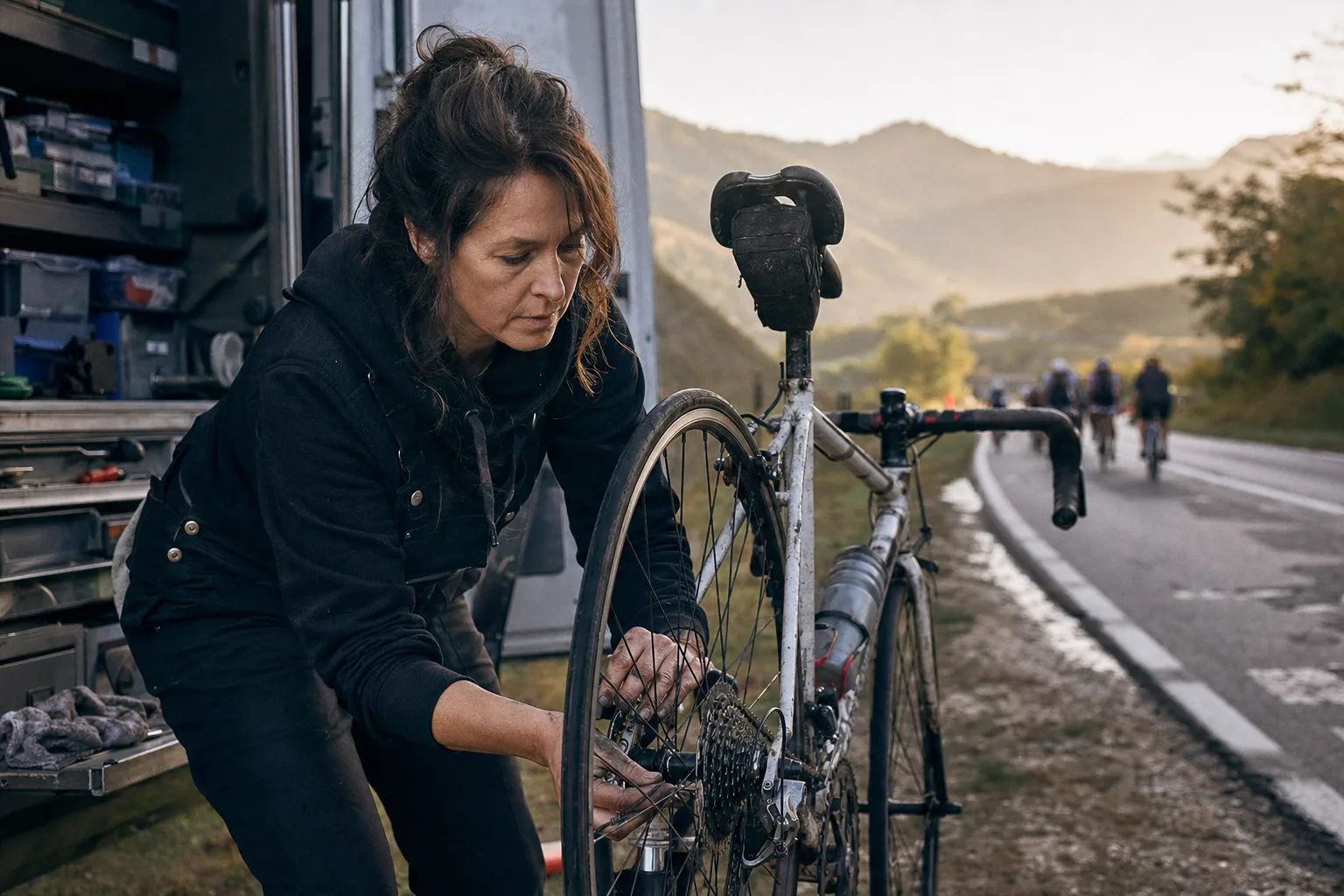
The race has already left when Mara Sanz opens the back of the van. Somewhere beyond the next bend, eighty riders are turning effort into a visible result. Here, beside a quiet road, the work is smaller and more exact. She checks the wheel dish, wipes a thumb across the chain and listens for the faint click that means the adjustment is not finished.
Riders know Sanz by the speed of her hands. She prefers to be known by how rarely those hands need to hurry. Before dawn she arranged the van so each tool could be found without looking. Wheels are ordered by rider and purpose. A strip of tape marks the drawer that slides open on rough roads. Preparation is not a performance of control; it is a way of preserving attention for the moment control fails.
The best repair is the one that lets somebody stop thinking about the bicycle.
Work without an audience
Race mechanics live inside contingency. They prepare for events they hope will not happen and become visible only when something has gone wrong. A clean day can make their work appear unnecessary. Sanz likes that paradox. The bicycle should disappear beneath the rider. The mechanic, too, is most successful when trust becomes quiet.
She learned in her uncle’s repair shop, where the difficult jobs were not always mechanical. A person would arrive with a neglected commuter bicycle and an apology. Her uncle ignored the apology. He asked where the person needed to go. The repair began with use, not judgment. Sanz carried that habit into racing, an environment where equipment can easily become a measure of belonging.
The shop also taught her to explain a repair without using knowledge as a barrier. Her uncle placed worn parts on the counter and let customers hold them. He described consequence before terminology. This pad is thin; in rain, stopping will take longer. Sanz still works that way with riders. Technical language matters, but it should clarify responsibility rather than establish rank.
In the team van, every rider receives the same careful check. Status changes which bicycle sits nearest the door, but not whether a bolt is inspected. Sanz dislikes the romantic idea that mechanical intuition replaces method. Intuition, she says, is often method practiced long enough to become fast.
Each bicycle carries a history known partly through touch. One rider brakes late and wears front pads quickly. Another notices a fraction of movement in the saddle. Sanz records these preferences but does not obey them automatically. Trust includes the willingness to say when a familiar setup is no longer safe or useful.
Thirty seconds of trust
The radio breaks into static. A rider has punctured two kilometers ahead. Sanz is moving before the message finishes, one wheel in hand. The van stops at an angle. The rider holds the bicycle upright and breathes through frustration. Sanz changes the wheel, checks the brake and pushes the saddle forward. The rider leaves without looking back.
Later, she will review what happened. Speed matters now, but speed without review becomes repetition of the wrong kind. Was the tire damaged by debris or pressure? Did the replacement sit correctly? Did the rider report anything after the finish? Each answer belongs to the next decision.
The rider finishes in the main group and thanks her with two fingers raised from the handlebar. It is enough. Mechanics and riders share a compressed vocabulary during a race because neither has spare attention. The fuller conversation comes later, when urgency no longer has authority over accuracy.
After the finish
The spectacle ends before the work. Bicycles return carrying dust, sweat and small explanations. A rider mentions a sound under load that disappeared on the descent. Another says nothing but leaves the handlebars turned slightly. Sanz begins again, restoring each machine to the condition of being trusted.
She works from the outside inward: damage visible to everyone, then the quieter systems that reveal themselves only under pressure. Cleaning is part of inspection. Dirt can hide a crack, and a polished surface can create false confidence, so appearance never completes the check. The bicycle must be understood, not merely made presentable.
A young assistant works beside her, asking when he should replace a cable that still functions. Sanz turns the question back: what would failure mean here, and what evidence suggests it is approaching? Parts do not carry identical consequences. Good maintenance is not maximum replacement. It is judgment about risk, use and the trust a rider will place in the machine tomorrow.
Teaching the eye and hand
The assistant, Luis, wants rules he can carry from one bicycle to the next. Sanz gives him sequences instead. Clean before judging. Confirm the complaint. Change one variable. Test under the condition where the problem appeared. Rules promise certainty; sequences preserve a path through uncertainty.
She also teaches him to ask riders for sensory language without correcting it too quickly. A bicycle can feel wooden, nervous, late or unwilling. None is a mechanical diagnosis, but each points toward circumstances worth recreating. Expertise translates experience; it should not dismiss experience for arriving in the wrong vocabulary.
On a training day, Sanz sends Luis to handle a straightforward adjustment alone. She watches from several meters away and intervenes only when he reaches for the wrong tool. The repair takes longer than it would in her hands. That extra time is not waste. A team that depends on one person has confused excellence with fragility.
Luis finishes and asks whether the work is good. Sanz asks him to test it, then explain the evidence. Approval is less useful than a repeatable way to verify. The bicycle goes onto a stand, then onto the road with a rider who knows it is a test. Confidence is built in stages rather than declared at the bench.
Later, Sanz writes his name beside the repair in the service record. Credit and accountability share the same line. If the adjustment holds, the record shows who can perform it again. If it does not, the record creates a conversation specific enough to improve the system rather than embarrass the learner.
Before closing the van, she lays out the tools needed at dawn. The action belongs to tomorrow but is performed by the tired person standing here tonight. Sanz trusts systems partly because systems allow one version of a person to care for another: the calm mechanic preparing for the hurried one, the experienced mechanic leaving a clear order for the assistant who will open first.
At the hotel she washes her hands twice and still finds grease at the edge of one nail. The race report lists winners, gaps and classifications. It does not list the adjustments made beside the road. Sanz reads it anyway. Results are part of the story, just not the whole of it. In the morning, the van will open before anyone is watching.