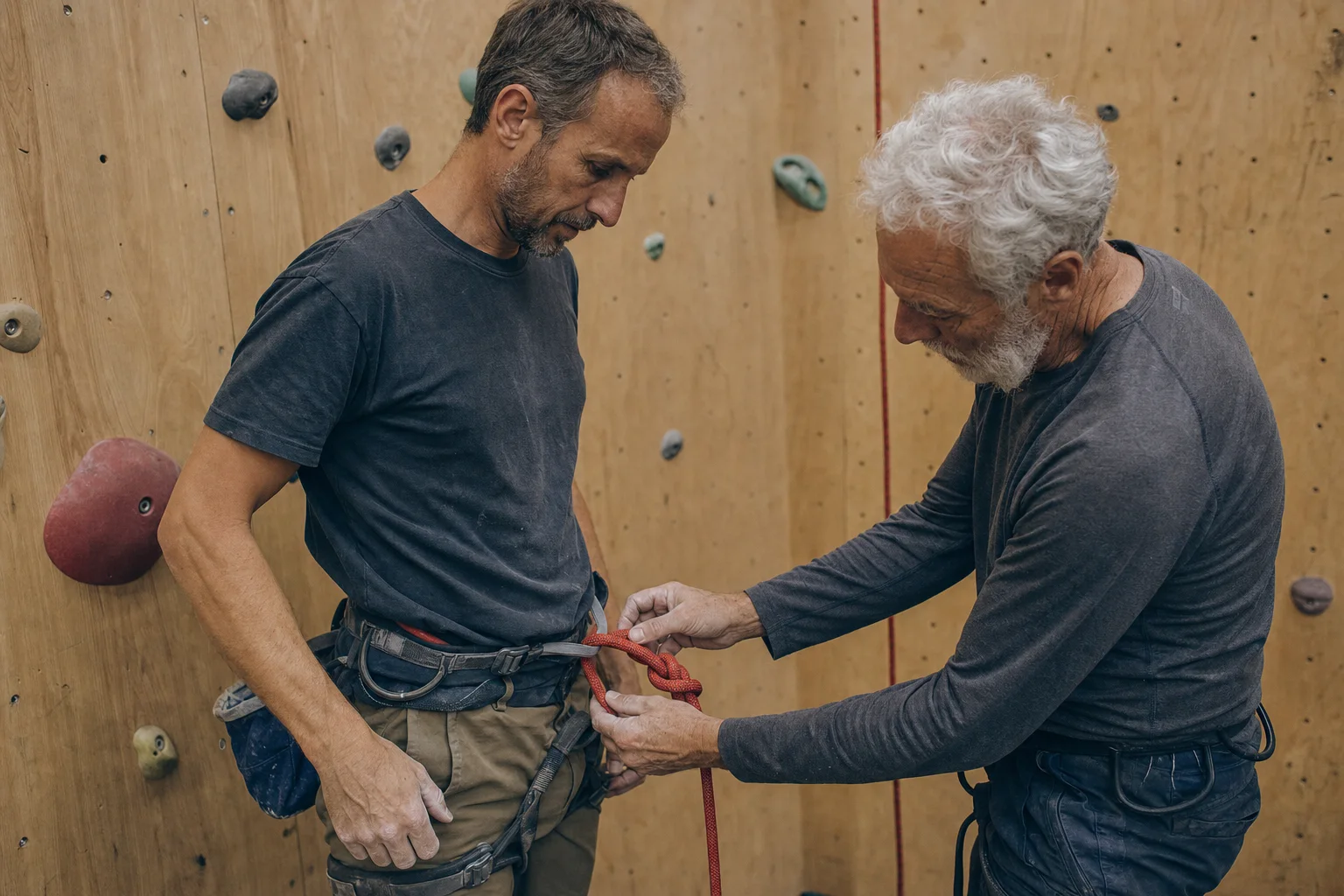
Before the doors open, Imani Rowe stands below the wall and watches another climber misunderstand what she has made. This is not a failure. Misunderstanding is part of the invitation. The climber reaches with the right hand, pauses, then returns to the floor smiling at the possibility that the wall may be asking for something else.
A good problem tells the truth slowly. The first hold suggests one movement, the body proposes another, and somewhere between them a person learns what balance feels like today. Rowe is responsible for arranging that conversation, but she cannot control it. Every climber brings a different reach, history and appetite for uncertainty.
I am not arranging holds. I am arranging questions.
Built to be revised
Rowe began setting because the walls she climbed rarely seemed to imagine her body. At five foot two, she became skilled at turning long reaches into dynamic movements. Coaches praised the adaptation. She wondered why adaptation always traveled in one direction. What would a route look like if shorter movement was not treated as a modification of the intended solution?
Her process begins on paper with a feeling rather than a sequence. Patience. Commitment. A change of mind. The words do not appear on the finished wall. They guide early choices, then recede as testing begins. If the concept survives only for people who move like Rowe, it has not survived.
Color, spacing and wall angle establish the first sentence. Rowe lays holds on padded flooring before attaching anything, looking for relationships rather than individual beauty. A dramatic hold can dominate a sequence and make every movement around it predictable. She often chooses the quieter object that leaves more than one idea alive.
She tests with climbers of different heights, strengths and habits. One finds a foothold nobody considered. Another bypasses the central movement entirely. Rowe resists defending the original idea. A route is not an argument the setter must win. It is a structure that becomes complete through use.
Testing also reveals fear. A move can be physically reasonable and emotionally abrupt if the landing feels uncertain or the next hold cannot be seen. Rowe climbs the problem while tired and asks a colleague unfamiliar with it to describe where confidence changed. Safety is technical, but the experience of safety is partly designed.
Difficulty without humiliation
Climbing gyms organize problems by grade, a practical system that can quickly become identity. Rowe wants difficulty to be legible without becoming a verdict. She pays attention to the opening move. Can a person begin and learn something before the route refuses them? Does failure offer information, or only distance?
This does not mean making every problem accessible to every climber. Constraint gives the wall character. But exclusion should be chosen consciously, not inherited from the setter’s own body. Rowe distinguishes between a route that asks for power and one that asks, accidentally, for a specific wingspan.
She keeps a photograph of each finished wall and almost never looks at it. The useful archive is social: which beginners stayed with a problem, where advice became too loud, which movement produced surprise rather than confusion. Those observations shape the next reset more than a picture of clean holds before opening.
Her colleagues challenge her in return. A route can become so open-ended that it loses a clear demand. Inclusion is not the absence of intention. Rowe values the argument because it keeps generosity from becoming vagueness. The wall should welcome different bodies into a specific conversation.
A temporary authorship
Routesetting is creative work built for erasure. The holds will come down before most climbers have finished thinking about them. Rowe finds relief in that timeline. It makes revision normal and discourages preciousness. A problem can be careful, memorable and still make room for the next person’s idea six weeks later.
Removal has its own method. Holds are cleaned, bolts inspected and damaged pieces retired. Setters discuss what happened on the wall without treating popularity as the only measure. A difficult problem attempted by few people may have served those climbers deeply. A popular problem may have repeated a movement the gym already offered everywhere.
Rowe looks for range across the room: quiet balance beside direct power, problems that reward patience, problems that permit commitment and at least one sequence a new climber can enter without already knowing the culture. No single wall can represent every body. A season of walls can reveal whether the team is genuinely trying.
The work has changed how she climbs. She spends less time asking whether a route suits her and more time asking what relationship it proposes. Sometimes she declines the proposal. Sometimes she discovers a movement she would never have designed. Being a maker has not made the room predictable; it has made surprise easier to respect.
Who gets to imagine the wall
Rowe now mentors two apprentice setters. She gives them sections of wall with real constraints and enough time to revise. Watching is harder than doing. She must distinguish a safety concern from a preference and allow an unfamiliar aesthetic to become coherent. Otherwise mentorship would reproduce her own movements under another person’s name.
The apprentices bring questions Rowe had stopped noticing. Why are starting holds placed at this height? Why do instruction sessions happen after work, excluding people on evening shifts? The design of a climbing room extends beyond plywood. Scheduling, pricing and who is trusted with tools all shape which bodies eventually influence the wall.
One apprentice creates a problem Rowe cannot solve in the intended way. Her first response is frustration, then interest. She asks for no hint and returns the next morning. For once, the room is teaching its teacher through hands other than her own.
The room changes hands
By noon, chalk has softened the colors. People gather beneath the new wall and exchange incomplete ideas. A child uses a hold Rowe expected adults to ignore. An experienced climber spends twenty minutes on the opening. The room becomes noisy with effort and advice.
Rowe watches for a while, then walks away. The problem no longer belongs to its maker. That is the point. In six weeks it will be removed, each hold returning to a bin before becoming part of another question. The learning remains distributed among hands that may never know her name.