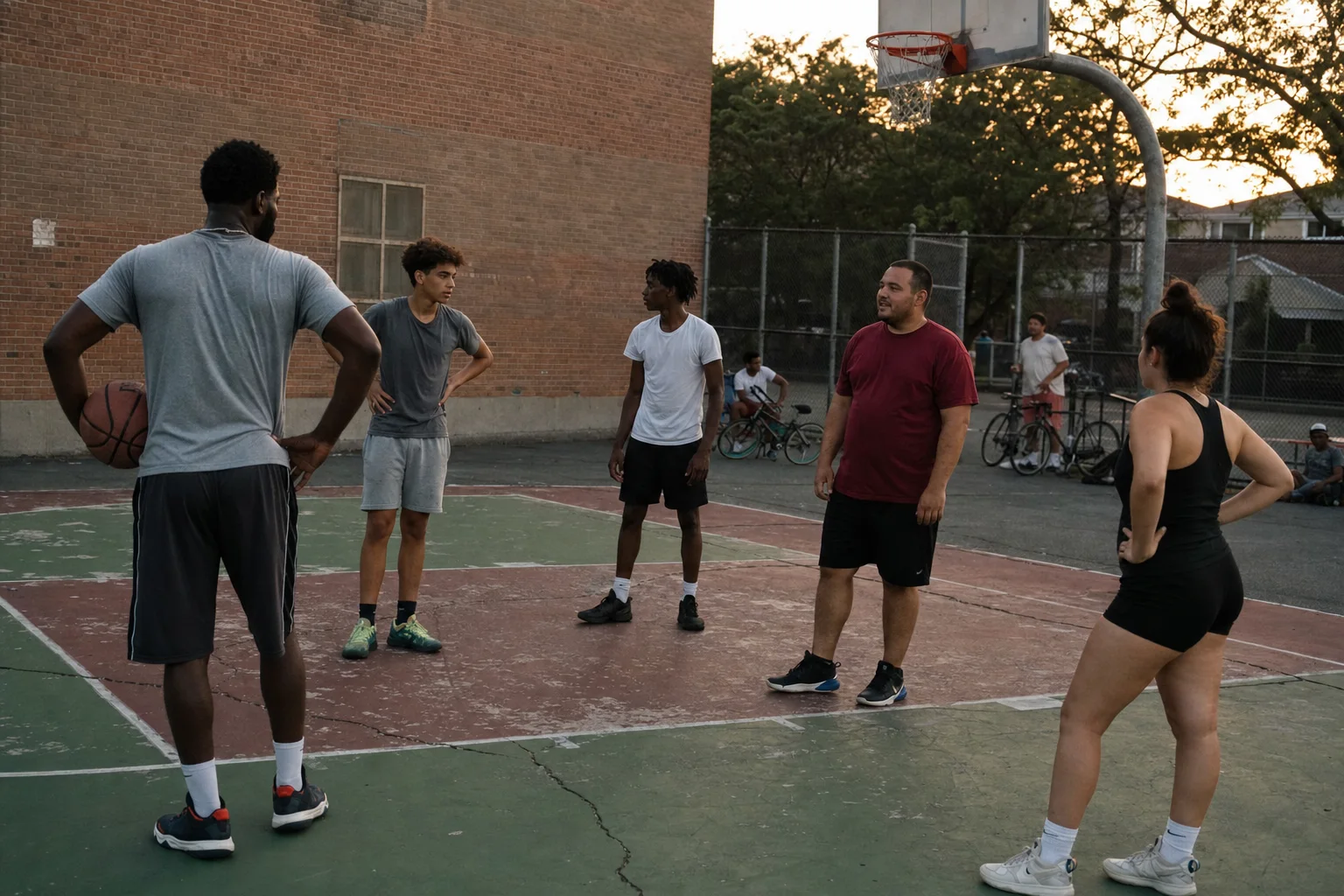
By seven in the evening the gym sounds different. The youngest players have gone home. The ball no longer echoes so much as keeps the room company. Leon Bell sits on the lowest bleacher and reties one shoe before making his final walk around the court. He checks the side door, the equipment room and the loose hinge on the cabinet nobody has found time to repair.
Bell has been associated with West Gym for so long that people tell stories about him in eras: before the new floor, after the roof leak, during the years when the school district stopped funding evening supervision. He corrects the details gently. Memory, he says, tends to make one person responsible for work that was always shared.
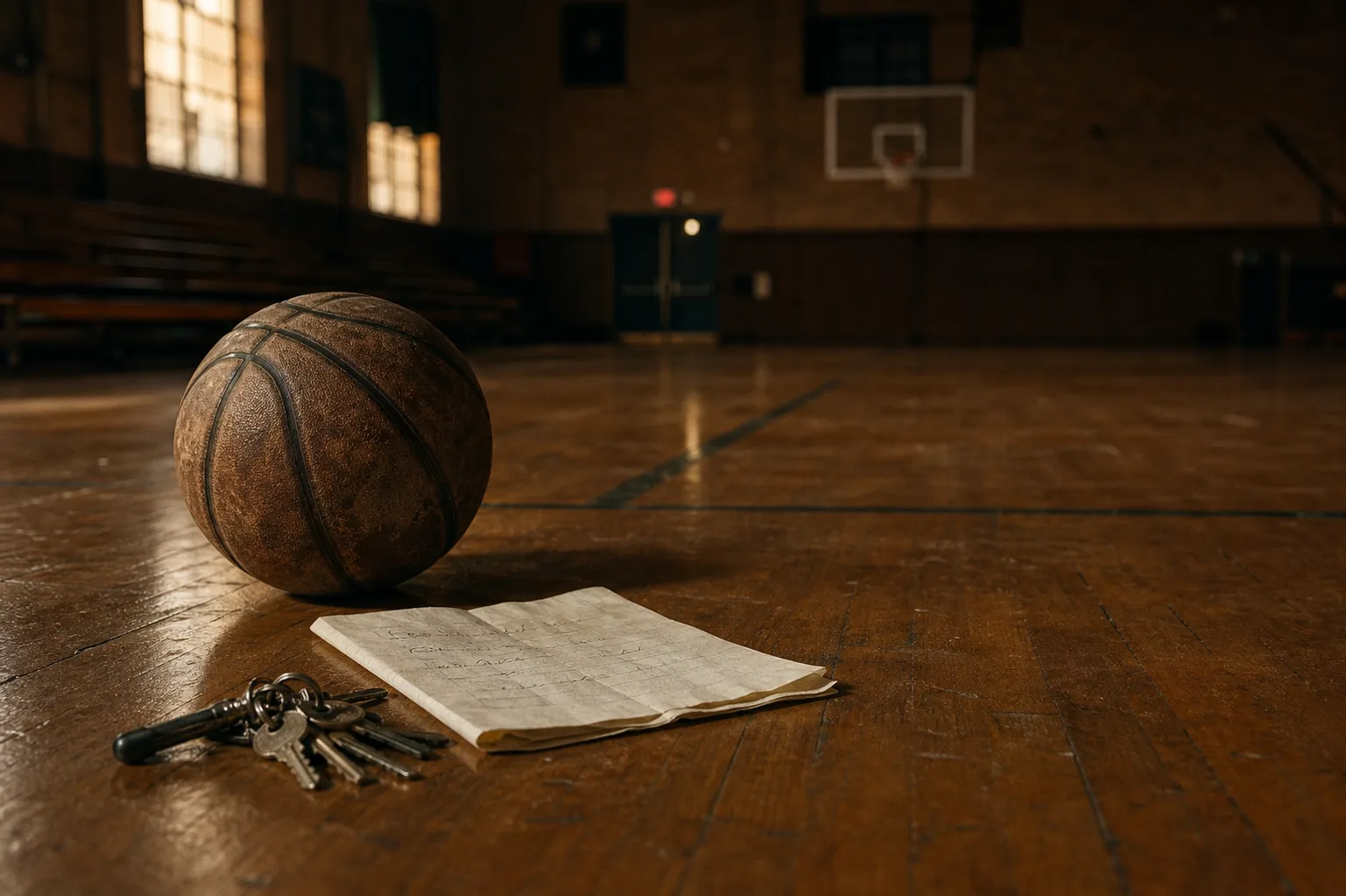
A gym is only useful if people believe there will be someone here when they arrive.
A place to return to
He first came through these doors as a thin twelve-year-old carrying shoes in a grocery bag. The coach at the time did not ask whether he could play. He pointed to a broom and said the court needed sweeping before anyone started. Bell remembers feeling useful before he felt talented. The distinction shaped everything that followed.
As a player, he was reliable and unspectacular. As an assistant, he noticed who had eaten and who was pretending not to be tired. When the head coaching job opened, Bell accepted on the condition that the building remain available for unstructured hours. Practice mattered, but so did the interval before it, when a child could arrive early without having to explain why home was difficult that afternoon.
The work beyond the drill
His sessions are orderly without being theatrical. Players begin by setting out cones and finish by returning the benches. Bell rarely raises his voice. He stops a drill when attention becomes careless, not when a shot is missed. The standard is not perfection. It is responsibility for the people sharing the floor.
Former players stop by without warning. Some bring children. Some bring apologies. One arrives in work boots and quietly repairs the cabinet hinge. Another sends money for new nets every winter but asks that no name be attached. Bell does not keep a formal record of these returns. The gym itself seems to hold them.
The final player on Thursday is a sixteen-year-old named Amir who has been working on the same left-handed finish for a month. Bell rebounds in silence. At eight fifteen, Amir makes three in a row and looks toward the bleachers. Bell nods once, then sends the ball back. The point is not the small streak. The point is learning that improvement can happen without an audience announcing it.
Passing on the keys
Bell knows the gym will eventually belong to somebody else. He has begun giving younger coaches the final hour, remaining nearby without directing it. They run different drills. Their music is louder. They use phrases he would never choose. He watches for the essential things: whether every player is seen, whether the doors open on time, whether the room is left ready for the next group.
One of those coaches, Simone Price, keeps her own spare key now. Bell gave it to her without ceremony after she arrived early for twelve consecutive Saturdays. She has added a girls’ open run and a quiet half-hour for beginners who do not yet want to join a game. The schedule looks different from Bell’s. The underlying promise is recognizable: there will be somebody here when you arrive.
What a record leaves out
Bell’s teams have won enough games for people to mention the total at ceremonies. He remembers fewer scores than former players expect. What stays are decisions: the night a team chose to forfeit because a teammate’s family needed help, the season captains asked for shorter practices during examinations, the player who returned after months away and spent the first week only watching.
He is not indifferent to winning. Preparation deserves the honesty of a score, and competition can reveal what practice has not. But a result is a narrow record. It cannot show who learned to speak, who made room, who repaired harm after anger or who discovered that responsibility could feel better than attention.
Bell keeps one box of photographs in the equipment room. The images are badly labeled and often show people whose names nobody can immediately recall. He brings the box out during alumni nights because collective memory needs disagreement. Someone recognizes a jersey, another corrects the year, and a person at the edge of the photograph is returned to the story.
The gym has failed people, too. Bell can name players he pushed before understanding what they were carrying and moments when discipline became a substitute for listening. He does not turn regret into proof of virtue. He apologizes where he can, changes the practice and tells younger coaches that longevity is not the same as being right for a long time.
A gym is not a solution
Bell is wary when visitors describe West Gym as saving children. A room cannot repair structural problems by remaining open, and a coach should not become the heroic answer to needs that require housing, food, healthcare and safe schools. The gym can offer continuity, relationships and a place to move. Those are substantial things without being everything.
He works with counselors and families when a problem exceeds basketball. This boundary took time to learn. Wanting to help can become another way of centering the helper. Bell now asks what role is actually his, what information he has permission to share and who is better equipped to continue the work.
The humility changes practice. Players are not treated as projects whose progress validates the coach. They can arrive, learn, struggle, leave and return without providing an inspiring ending. Bell’s responsibility is to make the room trustworthy while they are in it.
After Amir leaves, Bell turns off the lights in sections. The court disappears, then the bleachers, then the hallway photographs. At the side door he pauses with the keys in his hand. The building is empty, but it does not feel closed. Tomorrow someone else will arrive carrying shoes in the wrong kind of bag, hoping there is a place to put them.