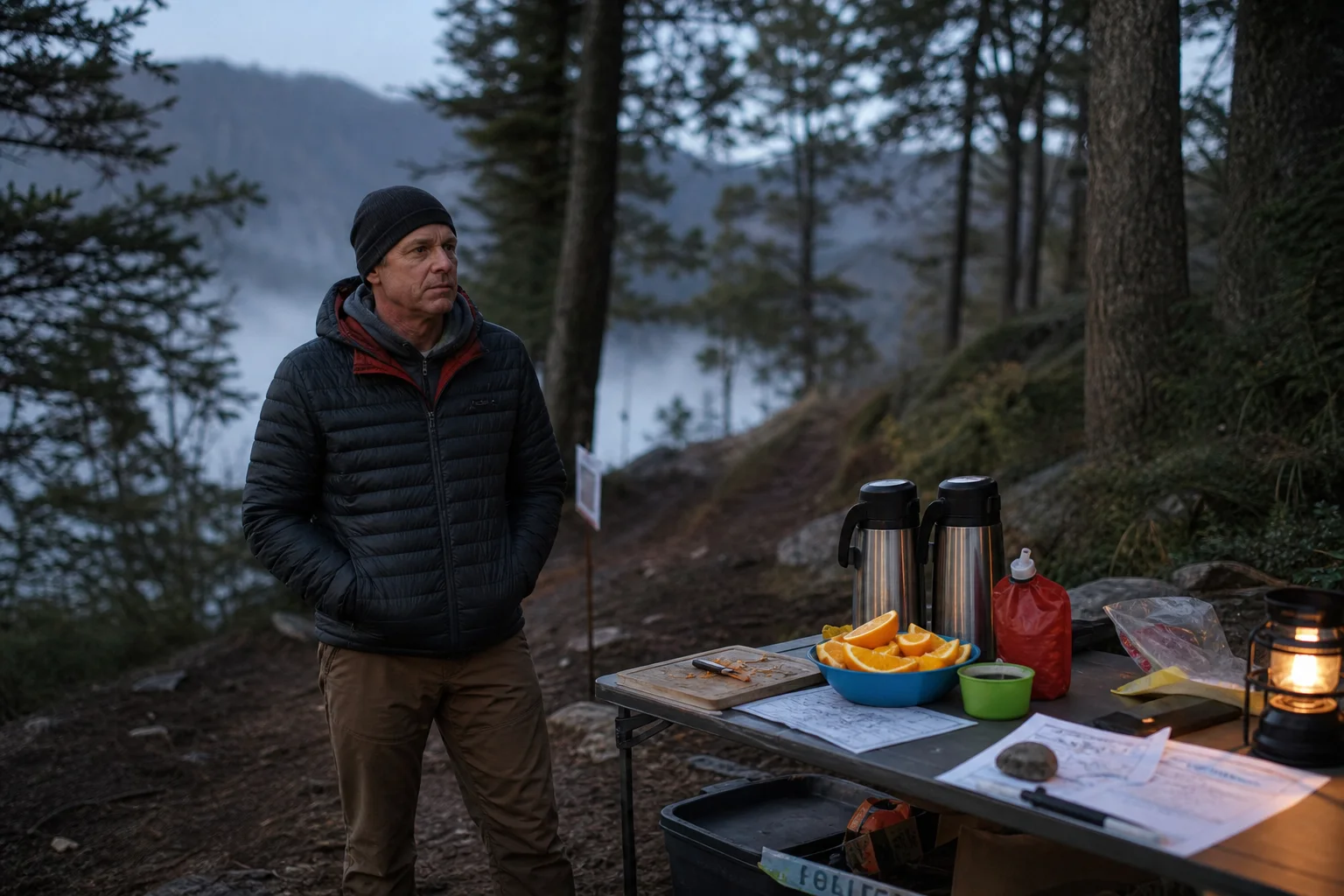
By the time Elias Ward opens the second thermos, the race has become quiet. The first runners came through in a quick bright sequence, asking for water without stopping and leaving the paper cups trembling on the table. Now there are minutes between footsteps. The forest has resumed its own scale. Rain gathers on the edge of the shelter and falls in heavy drops whenever the wind moves the branches.
Ward checks the list again. Seven people have not passed the station. He does not know whether they are still moving, have turned around or are sitting somewhere above the lake reconsidering the day. His job is not to guess. His job is to keep the soup warm, cut the remaining oranges and make the table look as ready for the last person as it did for the first.
The back of a race should not feel like the back of anyone’s attention.
He began volunteering after withdrawing from this same event with a swollen ankle. At the nearest station, someone pulled over a chair and handed him a cup before asking what had happened. Ward remembers the order of those gestures. Care arrived before explanation. The following year he returned with no intention of racing and asked where help was needed.
Ready for one person
At dusk a runner appears without urgency. She has mud to her knees and the distant expression of someone doing arithmetic with limited energy. Ward offers three choices, then waits. She chooses broth. Nobody tells her to hurry. The official cutoff is generous, but the more important permission is social: she is allowed to occupy this small place for as long as she needs to make a sound decision.
When she leaves, Ward writes the time beside her number and walks to the edge of the trail to watch until her headlamp turns. Six people remain on the list. The table is less abundant now, but it is still orderly. He wipes it down, refills the kettle and places the brightest orange at the front.
Near midnight the final runner arrives walking with a course marshal. Ward offers the same choices in the same order. Nothing about the welcome suggests that the important part of the day has already happened. When the runner smiles at the soup, Ward understands that keeping a station open is less about waiting for a race to finish than refusing to let attention finish early.
Packing takes another hour. Unopened food is counted for donation, waste is carried out and every scrap of tape is removed from the trees. Ward is tired enough to move slowly, which helps. The forest should not have to keep evidence of the welcome. By the time he leaves, the station has become an ordinary patch of ground again.
At breakfast the next morning, he will not know most finishing times. He will remember who needed salt, who wanted silence and which runner turned back after making a careful choice. From the station, the race is less a ranking than a procession of different needs passing through one small place.