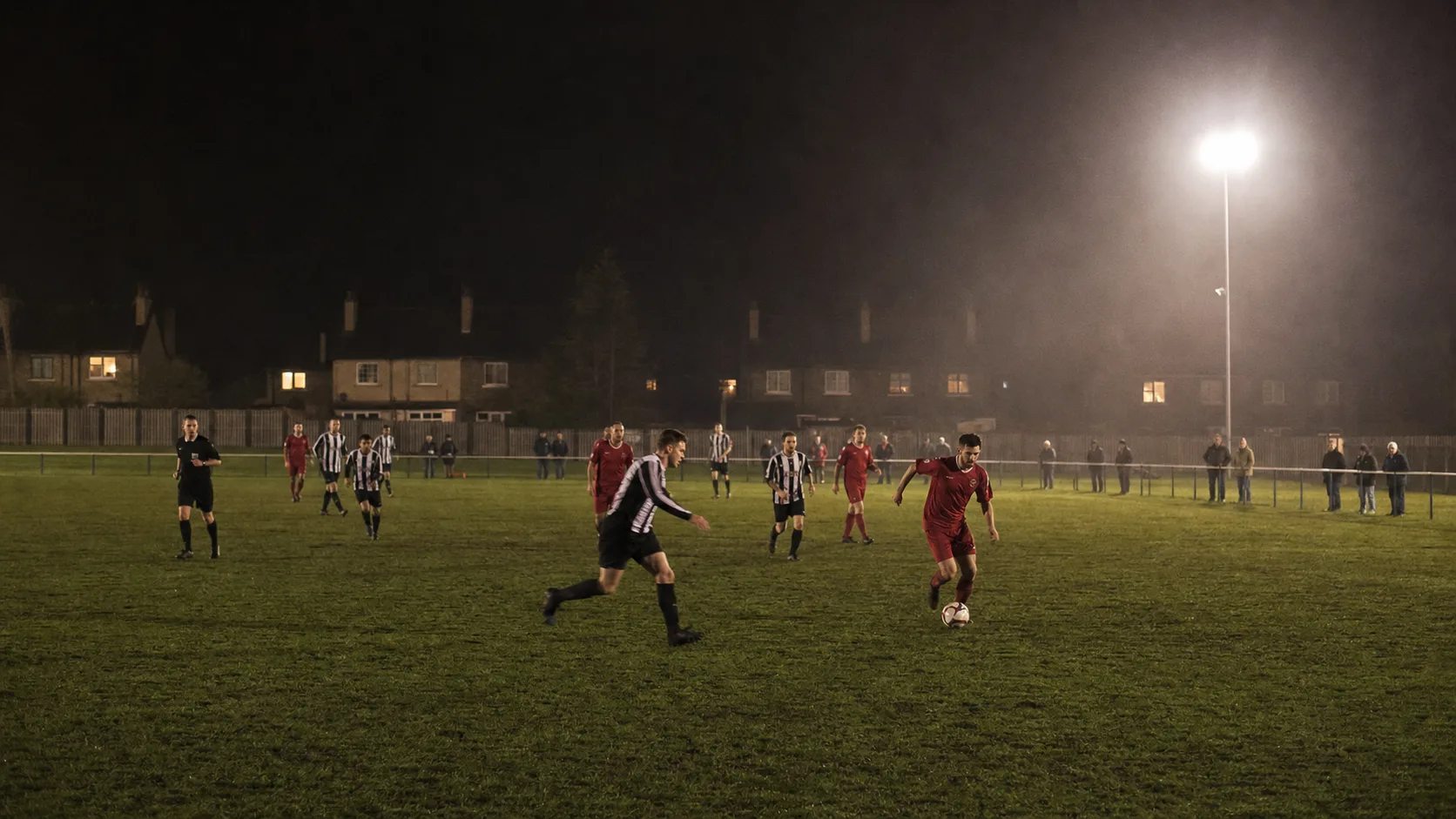
The crowd disappears in layers. First the people with trains to catch, then the people still finishing a conversation, then the ushers. The floodlights remain at full brightness while the stadium becomes visibly less important. Paper cups roll along the concrete. A chant survives in one stairwell and then stops.
When Tomas Ibarra walks onto the pitch, the stadium has stopped being a spectacle and returned to being a workplace. He carries a fork, a bucket and a radio turned low. From the highest seats his movement would be almost invisible, a single person crossing the immense green rectangle that occupied everyone’s attention an hour earlier.
People think empty means finished. Empty is when we can finally begin.
Reading the surface
Ibarra does not begin with the obvious damage near the goals. He walks diagonally, looking at how the grass lies. A match leaves patterns: repeated accelerations along one side, the concentrated turning of a warm-up area, a shallow divot where a player changed direction. The field is not a neutral stage. It records the event physically.
He joined the grounds team after years maintaining public parks. Stadium work looked more precise from the outside and more collaborative once he entered it. Weather changes every plan. Television schedules compress recovery. Concerts arrive with flooring that protects the grass and also changes how it breathes. The job is a sequence of compromises made in service of a surface that must appear uncomplicated.
Public parks taught him that a surface can belong to many uses without serving any of them perfectly. A goalmouth becomes a picnic area on Sunday. A touchline becomes the route to school. At the stadium, use is more controlled but no less layered. Players, officials, camera crews and ceremonies all make different demands of the same ground.
No final whistle
During matches, Ibarra watches differently from the crowd. Rain matters more than possession. A long slide in the penalty area produces a small note in his pocket. He enjoys the game, but enjoyment is braided with responsibility. When people celebrate a late goal, he notices where the substitutes have worn a path along the touchline.
His daughter once asked whether this divided attention spoiled football. Ibarra told her it gave him another game to follow. Beneath the contest between teams is a negotiation between movement and ground. Players ask the field to hold, release and remain consistent. The grounds crew listens for where that agreement begins to fail.
The overnight crew works without commentary. Divots are pressed back. Debris is removed by hand. Damaged areas are marked for morning. Nobody attempts to make the field new; the aim is to help a living surface recover enough to carry what comes next.
The morning crew
At six, another team will inspect moisture and decide which areas can be used for training. Ibarra’s notes are their first map. Groundskeeping is continuous work performed by people whose shifts rarely overlap completely. Trust travels through markings, photographs and the condition in which a tool is returned.
He takes pride in details spectators are not meant to notice: a repaired seam that does not change the ball, a line whose width remains constant through a worn patch, a corner where drainage has improved enough that rain is no longer a story. Invisibility is not the absence of craft. It is often the chosen result.
There are failures, too. A disease once spread through a shaded section despite weeks of treatment. The team replaced the turf and documented what they had missed. Ibarra rejects the idea that experience means always knowing. Experience has made him quicker to involve other people before a small uncertainty becomes an expensive certainty.
He keeps the old photographs, not as warnings but as evidence that maintenance includes admitting when repair is no longer enough. Stewardship sometimes means beginning again without pretending the previous work was wasted.
The people beneath the surface
Ibarra’s work depends on colleagues spectators rarely see: irrigation technicians, electricians, cleaners, safety staff and the person who knows which service gate will stick after heavy rain. Readiness is produced across departments that can easily become invisible to one another. He makes a point of learning names because a stadium does not become more humane when its labor becomes more specialized.
Before each event, representatives walk the ground together. A broadcast request can affect drainage access. A security barrier can change the route of maintenance equipment. The conversation prevents one team’s solution from becoming another team’s hazard. Ibarra likes this part of the job: expertise arriving not as authority over the whole place, but as responsibility for one part of a shared decision.
New staff often expect the pitch to be guarded like sacred ground. Ibarra teaches care without mystique. Boots are cleaned, routes are chosen and unnecessary traffic is avoided, but the field exists to be used. Protecting it from every mark would be another kind of failure.
On community days, children step onto the grass and immediately look down. The surface they have seen on screens is suddenly individual blades, damp soil and repaired seams. Ibarra watches them understand that the famous rectangle is made of ordinary living material. For a moment, maintenance becomes visible because wonder has changed scale.
A season beneath a season
Supporters experience the year through fixtures. Ibarra experiences another calendar beneath it: germination, heat stress, reduced daylight and the narrow windows when deeper work is possible. The two seasons overlap imperfectly. A crucial match may arrive when the grass most needs rest. His craft is to negotiate without asking the public to care about every compromise.
He walks the field differently in winter, pressing a heel into the soil and watching how quickly water returns. In summer he looks for color changes near the edges first. Technology provides measurements, but the daily walk keeps data connected to place. A sensor can report moisture; it cannot notice that one corner smells wrong after rain.
Ibarra will retire before the stadium replaces its current drainage system. He is helping document the ground for people who will work with changes he never sees. This future-facing labor matters to him. Maintenance is not possession of a place. It is leaving useful knowledge for the next person responsible for it.
Near midnight, the stadium lights step down. Ibarra can finally see the city beyond the open corners. The field changes color in the reduced light and looks smaller, almost domestic. He completes one final diagonal and leaves the bucket beside the tunnel. In three days, forty thousand people will return and call the place ready. Readiness will look effortless. That is part of the craft.